
Digital SAT vs Paper SAT: Complete Comparison Guide 2025
 By Anna Choongo
Table of Contents
Digital SAT vs Paper SAT: The Transition to Digital Testing
In March 2024, the College Board completed its full transition from the traditional Paper SAT to the Digital SAT. This represents the most significant change to the SAT in its history, fundamentally transforming how students take and prepare for this crucial college admissions test.
Timeline of the Transition:
- March 2023: International students begin taking Digital SAT
- March 2024: U.S. students transition to Digital SAT exclusively
- 2025 and beyond: All SAT administrations are digital only
- Paper SAT: No longer administered anywhere globally
Understanding the differences between the Digital SAT and Paper SAT is crucial for students who took the Paper SAT for PSAT or older practice, as well as those comparing practice materials. This comprehensive guide explains everything you need to know about the SAT format comparison.
Why the Change to Digital?
The College Board cites several reasons for the digital transition:
- Shorter test time: Reduce student fatigue and stress
- More relevant content: Passages from recent sources and current topics
- Faster score delivery: Results in days instead of weeks
- Enhanced security: Unique test forms for each student reduce cheating
- Better measurement: Adaptive testing provides more precise ability assessment
- Improved accessibility: Built-in tools and accommodations easier to implement
Key Differences: Quick Comparison Table
Here's a comprehensive SAT format comparison showing the major differences:
| Feature | Paper SAT (Pre-2024) | Digital SAT (2024+) |
|---|---|---|
| Test Format | Paper booklet + answer sheet | Digital via Bluebook app |
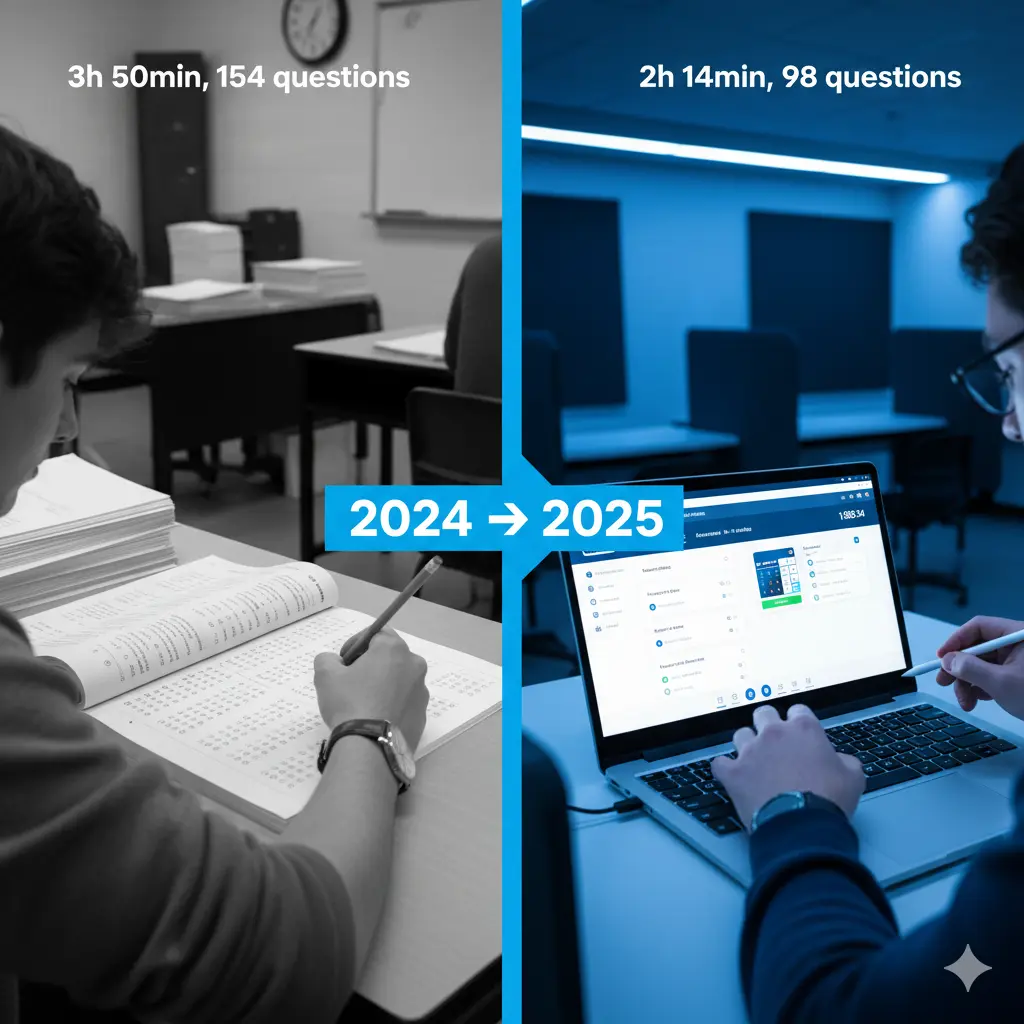
| Total Duration | 3 hours, 50 minutes (including breaks) | 2 hours, 14 minutes (including breaks) |
| Total Questions | 154 questions | 98 questions |
| Test Sections | Reading, Writing & Language, Math (2 sections) | Reading & Writing (combined), Math |
| Reading Passages | Long passages (500-750 words), 10-11 questions each | Short passages (25-150 words), 1 question each |
| Adaptive Testing | No - same questions for all students | Yes - adapts based on Module 1 performance |
| Calculator Policy | No calculator section + calculator section | Calculator allowed throughout entire Math section |
| Built-in Tools | None (bring your own materials) | Graphing calculator, timer, highlighter, notes, flag questions |
| Score Range | 400-1600 (200-800 per section) | 400-1600 (200-800 per section) |
| Score Release | 2-3 weeks | 2-3 days |
| Test Security | Same test form for all students on a date | Unique test forms for each student |
Use our SAT Score Calculator to calculate your Digital SAT scores from practice tests and track your progress.
Test Format & Structure Differences
The structural changes between Digital SAT vs Paper SAT go beyond just the delivery method:
Reading & Writing Section
Paper SAT Format
- Separate sections: Reading (65 min) and Writing & Language (35 min)
- Long passages: 5 passages of 500-750 words each for Reading
- 10-11 questions: Per passage, requiring extensive passage navigation
- Total questions: 52 Reading + 44 Writing & Language = 96 questions
- Passage types: Literature, historical documents, science, social studies
Digital SAT Format
- Combined section: Reading & Writing together in two 32-minute modules
- Short passages: Brief 25-150 word passages
- One question per passage: More focused, less overwhelming
- Total questions: 54 questions (27 per module)
- Integrated content: Mix of reading comprehension and grammar in one section
Key Advantage of Digital Format:
The shorter passages mean you don't need to hold complex narrative or argument structure in your mind while answering multiple questions. Each question stands alone, reducing cognitive load and test anxiety.
Math Section
Paper SAT Format
- Two sections: 25-minute no-calculator + 55-minute calculator section
- 58 total questions: 20 in no-calc, 38 in calc section
- Calculator restrictions: Had to bring your own approved calculator
- Grid-in questions: Bubble answer sheets for numerical answers
Digital SAT Format
- Two modules: Both 35 minutes, calculator allowed throughout
- 44 total questions: 22 per module
- Built-in Desmos calculator: Graphing calculator available on every question
- Type-in answers: Enter numerical answers directly (no grid-in bubbling)
- Reference sheet: Digital access to formulas whenever needed
For detailed math strategies, check our SAT score improvement guide.
Adaptive Testing: How the Digital SAT Adapts
The most revolutionary aspect of the Digital SAT 2025 is its adaptive testing algorithm. Understanding this is crucial for test strategy.
How Multistage Adaptive Testing Works
The Two-Module Adaptive System:
- Module 1 (Baseline): All students receive a medium-difficulty first module
- Performance Analysis: The system analyzes your Module 1 accuracy
- Module 2 (Adaptive): Based on Module 1 performance:
- High performers: Receive harder Module 2 with higher scoring potential
- Medium performers: Receive medium-difficulty Module 2
- Lower performers: Receive easier Module 2
- Final Scoring: Your score reflects both raw performance and question difficulty
What This Means for Test Takers
| Module 1 Performance | Module 2 Difficulty | Score Implications |
|---|---|---|
| Strong (18+ correct) | Hard module | Higher ceiling score potential (700-800) |
| Medium (12-17 correct) | Medium module | Mid-range scoring (500-700) |
| Lower (0-11 correct) | Easy module | Limited ceiling (200-550) |
Strategic Implications of Adaptive Testing
- Module 1 is crucial: Performance determines your scoring potential
- Don't rush Module 1: Take time to maximize accuracy
- Don't panic if Module 2 is hard: Harder questions = higher score potential
- Easy Module 2 doesn't mean failure: You can still score reasonably well
- Every question counts equally: In raw scoring within each difficulty level
Paper SAT vs Digital SAT: Testing Philosophy
The Paper SAT gave everyone the same questions, measuring ability through a fixed set of items. The Digital SAT uses fewer questions but selects them strategically based on your demonstrated ability, providing more precise measurement with less testing time.
Timing & Test Length Comparison
One of the most significant differences in the SAT format comparison is the dramatic reduction in test time.
Complete Timing Breakdown
| Component | Paper SAT | Digital SAT | Time Saved |
|---|---|---|---|
| Reading Section | 65 minutes (52 questions) | 64 minutes total (54 questions, 2 modules) | 1 minute |
| Writing Section | 35 minutes (44 questions) | Integrated with Reading | 35 minutes |
| Math Section | 80 minutes (58 questions) | 70 minutes (44 questions, 2 modules) | 10 minutes |
| Breaks | ~30 minutes total | ~10 minutes total | 20 minutes |
| Total Time | 3 hours 50 minutes | 2 hours 14 minutes | 1 hour 36 minutes |
Time Per Question Analysis
Reading & Writing Time Per Question:
- Paper SAT Reading: 75 seconds per question (but need to read long passages first)
- Paper SAT Writing: 48 seconds per question
- Digital SAT R&W: 71 seconds per question (includes reading short passage)
Math Time Per Question:
- Paper SAT (no calc): 75 seconds per question
- Paper SAT (calc): 87 seconds per question
- Digital SAT Math: 95 seconds per question
Impact on Test Experience
The shorter Digital SAT significantly reduces:
- Mental fatigue: Less exhaustion means better performance on later sections
- Physical discomfort: Shorter sitting time reduces bodily stress
- Anxiety accumulation: Less time to build up test anxiety
- Scheduling conflicts: Finishes earlier in the day
- Opportunity cost: Less of your Saturday devoted to testing
Scoring Differences Between Digital and Paper SAT
While both formats use the same 400-1600 scale, the scoring process differs significantly.
Score Scale Comparison
| Score Component | Paper SAT | Digital SAT | Status |
|---|---|---|---|
| Total Score Range | 400-1600 | 400-1600 | Identical |
| Section Scores | 200-800 each (Reading/Writing, Math) | 200-800 each (R&W, Math) | Identical |
| Subsection Scores | 10-40 for Reading, Writing, Math (2 sections) | Not provided separately | Different |
| Cross-Test Scores | Analysis in Science, History/Social Studies | Not provided | Removed |
| Percentiles | National and state percentiles | National percentiles | Similar |
How Adaptive Scoring Works
The Digital SAT's scoring algorithm is more complex than the Paper SAT's:
Digital SAT Scoring Process:
- Module 1 scored: Determines adaptive path for Module 2
- Module 2 difficulty assigned: Easy, medium, or hard
- Module 2 scored: With difficulty weighting applied
- Combined scoring: Both modules contribute to final scaled score
- Equating applied: Ensures fairness across different test forms
Score Equivalency
The College Board designed the Digital SAT to be score-equivalent to the Paper SAT:
- Colleges treat them identically: No preference for one format over another
- Same percentiles: A 1400 on Digital SAT = 1400 on Paper SAT in college admissions
- Scholarship eligibility: Digital and Paper scores treated equally
- Score reporting: Both appear the same on official score reports
Calculate your Digital SAT scores using our SAT Score Calculator to see how you measure up against university requirements.
Score Release Timeline
| Process | Paper SAT | Digital SAT |
|---|---|---|
| Score Availability | 13-15 days after test | 2-3 days after test |
| Multiple Choice Scores | Same as total score release | Same as total score release |
| Essay Score (if taken) | 5-7 days after MC scores | N/A (essay discontinued) |
| Score Report Details | Available online immediately | Available online immediately |
Pros & Cons of Each Format
Both the Digital SAT and Paper SAT have advantages and disadvantages depending on student preferences and learning styles.
Digital SAT Advantages
| Advantage | Why It Matters |
|---|---|
| Shorter Test (2h 14min) | Reduced fatigue leads to better performance, less stress, easier to maintain focus |
| Fewer Questions (98 vs 154) | Less overwhelming, more time per question, reduced cognitive load |
| Built-in Tools | Graphing calculator, highlighter, notes, timer all provided—no need to bring supplies |
| Shorter Passages | Easier to understand and remember key details, less intimidating |
| Fast Score Release | Get results in 2-3 days instead of 2-3 weeks, better for application planning |
| Calculator Throughout | No mental math pressure, can use calculator on all math questions |
| More Time Per Math Question | 95 seconds vs 75-87 seconds allows for careful work |
| Unique Test Forms | Enhanced test security, reduced ability to share answers |
Digital SAT Disadvantages
| Disadvantage | Why It Matters |
|---|---|
| Screen Reading Required | Some students prefer reading on paper; eye strain possible |
| Digital Annotation Less Familiar | Highlighting on screen different from underlining with pencil |
| Technical Anxiety | Worry about computer glitches, battery issues, or software problems |
| Adaptive Pressure | Knowing Module 1 affects Module 2 difficulty can increase stress |
| Less Physical Navigation | Can't flip through booklet to see all questions at once |
| Requires Digital Literacy | Must be comfortable navigating digital interface under time pressure |
Paper SAT Advantages (Historical Context)
While the Paper SAT is no longer offered, understanding its advantages helps explain student preferences:
- Familiar format: Traditional pencil-and-paper testing students grew up with
- Physical annotation: Natural underlining, circling, note-taking
- No technical concerns: No worry about crashes, battery life, or connectivity
- Full test view: Could flip through entire section to see all questions
- Scratch work freedom: Unlimited space in test booklet for calculations
Paper SAT Disadvantages (Historical Context)
- Nearly 4 hours long: Exhausting length led to fatigue-induced errors
- 154 questions: Overwhelming volume of questions to complete
- Long score wait: 2-3 weeks for results created application timing challenges
- Bubbling errors: Could misbubble answer sheets under time pressure
- No calculator section: Mental math requirements increased difficulty
- Long passages: Dense 500-750 word passages were intimidating
Which Format is Easier? Digital SAT vs Paper SAT
The most common question in any SAT format comparison is: which one is easier?
The Consensus: Digital SAT is Generally More Manageable
Most students and educators agree that the Digital SAT is easier to manage, though not necessarily easier content-wise. Here's why:
Why Digital SAT Feels Easier
| Factor | Digital SAT Advantage | Impact |
|---|---|---|
| Test Length | 42% shorter (2h 14min vs 3h 50min) | Significantly reduced fatigue |
| Question Count | 36% fewer questions (98 vs 154) | Less overwhelming, more manageable |
| Reading Passages | 70-90% shorter per passage | Easier to comprehend and remember |
| Math Tools | Calculator throughout + graphing capability | Reduces calculation errors, saves time |
| Time Pressure | More time per math question (95s vs 75-87s) | Allows for careful problem-solving |
Why Digital SAT Can Be Harder
However, some aspects make the Digital SAT more challenging for certain students:
- Adaptive difficulty: Strong performers face harder questions in Module 2
- Screen reading: Students who struggle with digital reading at disadvantage
- Shorter passages = more switching: Less time to settle into passage content
- One question per passage: Can't use multiple questions to build understanding
- Psychological pressure: Knowing performance determines next module difficulty
Who Benefits Most from Digital Format?
Digital SAT is Better For:
- Students with stamina issues: Shorter test reduces fatigue problems
- Math-focused students: Calculator throughout math section helps
- Digital natives: Comfortable reading and working on screens
- Students who struggle with long passages: Shorter texts easier to process
- Test-anxious students: Shorter duration means less time to spiral
- Students needing accommodations: Digital tools easier to implement
Student Performance Data
Early data from the Digital SAT transition shows:
- Similar score distributions: Digital scores align with historical Paper SAT scores
- Reduced score variance: Adaptive testing provides more precise measurement
- Improved completion rates: Fewer students fail to finish sections
- Higher student satisfaction: Students prefer shorter, digital format
For strategies to maximize your Digital SAT performance, read our SAT Reading Strategies guide.
Frequently Asked Questions
The Digital SAT is generally considered more manageable due to its shorter duration (2h 14min vs 3h 50min), fewer questions (98 vs 154), and built-in tools like a graphing calculator. However, adaptive testing means questions get harder if you perform well on Module 1. Most students find the shorter format less exhausting, which often leads to better overall performance despite adaptive difficulty.
The Digital SAT uses multistage adaptive testing (MST). Each section has two modules: based on your Module 1 performance, the algorithm assigns you an easy, medium, or hard Module 2. Higher performers receive harder questions with greater scoring potential, while lower performers receive easier questions. This allows for more precise ability measurement with fewer total questions than a fixed-form test.
No, the Paper SAT was fully phased out in 2024. All SAT administrations in 2025 and beyond are digital only, administered via the Bluebook app on computers or tablets at test centers or school-based testing. There are no exceptions for U.S. or international students—everyone takes the Digital SAT.
Yes, Digital SAT scores are on the same 400-1600 scale and are designed to be completely equivalent to Paper SAT scores. The College Board used extensive equating studies to ensure that a 1400 on the Digital SAT represents the same ability level as a 1400 on the Paper SAT. Colleges treat Digital and Paper scores identically in admissions decisions.
The Bluebook app automatically saves your progress after every answer. If technical issues occur (computer crash, power outage, software glitch), you can resume exactly where you left off once the issue is resolved. You'll receive additional time to compensate for the interruption. Test center staff are trained to handle technical problems, and backup devices are available if needed.
It depends on your test center. Many school-based administrations provide devices, while some test centers require students to bring their own laptops or tablets. Check your admission ticket for specific requirements. If bringing your own device, it must have the Bluebook app installed and tested before test day. Devices must be fully charged (though test centers typically have chargers available).
Yes, within each module, you can navigate forward and backward freely to review and change answers. You can flag questions for later review and use the question navigator to jump to specific questions. However, once you complete and submit a module, you cannot return to it. This is similar to the Paper SAT where you could change answers within a section but not after time was called.
Preparation strategies are similar, but Digital SAT prep should include: (1) practicing with the Bluebook app to familiarize yourself with digital tools, (2) reading practice on screens rather than paper, (3) using the built-in Desmos calculator during practice, and (4) focusing on shorter passages with single questions. Content knowledge requirements are the same, but test-taking strategies should account for the digital format and adaptive testing. Use our SAT Score Calculator to track your practice test progress.
Conclusion: Embracing the Digital SAT in 2025
The transition from Paper SAT to Digital SAT represents the most significant evolution of the test in decades. While change can feel uncomfortable, the Digital SAT offers substantial improvements for most students.
Key Takeaways from Digital vs Paper SAT:
- Shorter is better: 2h 14min vs 3h 50min reduces fatigue significantly
- Fewer questions, more focus: 98 vs 154 questions feels more manageable
- Adaptive testing is fair: Provides precise measurement while reducing test length
- Built-in tools help: Calculator, highlighter, and timer support success
- Scores are equivalent: Colleges treat Digital and Paper scores identically
- Faster results: 2-3 days vs 2-3 weeks aids application planning
- Practice is essential: Familiarize yourself with Bluebook and digital format
Your Digital SAT Preparation Action Plan
- Download Bluebook: Install the official Digital SAT app on your device
- Take diagnostic test: Complete a full practice test to establish baseline
- Calculate your score: Use our SAT Score Calculator to see where you stand
- Practice with digital tools: Use the highlighter, calculator, and notes features
- Focus on Module 1: Strong Module 1 performance unlocks higher scoring potential
- Read on screens: Practice reading comprehension on digital devices
- Master short passages: Practice with Digital SAT's brief passage format
- Check requirements: Verify target school score ranges in our university requirements guide
The Bottom Line
While the Digital SAT vs Paper SAT debate may continue among students who experienced both, the reality is clear: the Digital SAT is here to stay, and it offers meaningful improvements for most test-takers. The shorter duration, built-in tools, and faster score release make the testing experience significantly better.
Rather than lamenting the loss of the Paper SAT, embrace the Digital SAT's advantages. Practice with official Digital SAT materials, familiarize yourself with the Bluebook app, and develop strategies that leverage the digital format's strengths. The students who succeed on the Digital SAT are those who adapt their preparation to the new format rather than trying to apply old Paper SAT strategies.
For comprehensive preparation strategies, explore our guides on improving your SAT score by 200+ points and mastering SAT reading comprehension. Both include Digital SAT-specific advice to maximize your performance on test day.
Ready to conquer the Digital SAT? Download Bluebook, take a practice test, and use our calculator to track your progress toward your target scores!
About the Author