
SAT Score Requirements for Top 50 US Universities 2025
 By Anna Choongo
Table of Contents
Understanding SAT Score Requirements
When planning your college applications, understanding SAT score requirements for top universities is crucial. The SAT remains one of the most important standardized tests for college admissions, even as many schools adopt test-optional policies.
What is the Middle 50% Score Range?
The middle 50% represents the SAT scores of the middle half of accepted students. If a school's range is 1450-1550:
- 25% of accepted students scored below 1450
- 50% of accepted students scored between 1450-1550
- 25% of accepted students scored above 1550
This range gives you a realistic target for competitive applications.
The university SAT scores listed in this guide reflect the most recent admissions data for the Class of 2028 and are based on official university statistics and College Board data. Use our SAT Score Calculator to see where your current scores fall within these ranges.
Why SAT Scores Still Matter
Despite test-optional policies at many institutions, submitting competitive SAT scores offers several advantages:
- Academic Validation: Demonstrates college readiness across standardized metrics
- Scholarship Opportunities: Many merit scholarships require SAT scores
- Competitive Edge: Strong scores strengthen applications in competitive pools
- Course Placement: Used for placement in college-level courses
- Out-of-State Applications: Particularly important for public universities
Ivy League SAT Score Requirements
The Ivy League SAT scores are among the highest in the nation. All eight Ivy League schools maintain extremely selective admissions with acceptance rates below 10%.
| University | Middle 50% SAT Range | Acceptance Rate | Testing Policy 2025 |
|---|---|---|---|
| Harvard University | 1490-1580 | 3.2% | Test-Optional |
| Princeton University | 1500-1580 | 4.0% | Test-Optional |
| Yale University | 1480-1580 | 4.5% | Test-Optional |
| Columbia University | 1490-1570 | 3.9% | Test-Optional |
| University of Pennsylvania | 1480-1570 | 5.9% | Test-Optional |
| Dartmouth College | 1470-1560 | 6.2% | Test-Required |
| Brown University | 1480-1570 | 5.1% | Test-Optional |
| Cornell University | 1470-1560 | 7.3% | Test-Optional |
Important Note on Dartmouth: Dartmouth College reinstated its test-required policy for the 2025-2026 admissions cycle, making it the first Ivy League school to reverse its test-optional stance.
Ivy League Score Analysis
To be competitive for Ivy League schools:
- Target Score: Aim for 1500+ to be within or above the middle 50%
- Minimum Competitive: 1470+ puts you in the lower range
- Super Competitive: 1550+ places you in the top 25%
Track your progress toward these goals using our SAT Superscore Calculator to see your best combined scores across multiple test dates.
Top 10 Universities SAT Score Requirements
Beyond the Ivy League, several other institutions rank among America's top 10 universities with equally impressive SAT score requirements.
| University | Middle 50% SAT Range | Acceptance Rate | Testing Policy 2025 |
|---|---|---|---|
| Massachusetts Institute of Technology | 1520-1580 | 4.0% | Test-Required |
| Stanford University | 1500-1580 | 3.7% | Test-Optional |
| California Institute of Technology | 1530-1580 | 3.0% | Test-Required |
| Duke University | 1490-1570 | 6.0% | Test-Optional |
| Johns Hopkins University | 1510-1570 | 7.2% | Test-Optional |
| Northwestern University | 1480-1560 | 7.0% | Test-Optional |
Notable Highlights for Top 10 Schools
MIT and Caltech Requirements:
Both MIT and Caltech maintain test-required policies due to their highly technical curricula. MIT specifically states that standardized testing helps assess readiness for their rigorous STEM programs.
- MIT requires SAT or ACT (Math Subject Test recommended)
- Caltech requires SAT or ACT with strong math scores
- Both schools have the highest average SAT scores nationally
SAT Requirements for Universities Ranked 11-20
Schools ranked 11-20 maintain highly competitive SAT score requirements while offering slightly broader acceptance rates than the top 10.
| University | Middle 50% SAT Range | Acceptance Rate | Testing Policy |
|---|---|---|---|
| University of Chicago | 1500-1570 | 5.4% | Test-Optional |
| Vanderbilt University | 1480-1570 | 6.7% | Test-Optional |
| Washington University in St. Louis | 1480-1560 | 11.0% | Test-Optional |
| Rice University | 1490-1570 | 8.7% | Test-Optional |
| University of Notre Dame | 1450-1550 | 13.0% | Test-Optional |
| Georgetown University | 1410-1540 | 12.0% | Test-Required |
| University of California, Berkeley | 1310-1530 | 11.4% | Test-Blind |
| University of California, Los Angeles | 1290-1520 | 9.0% | Test-Blind |
| Carnegie Mellon University | 1480-1560 | 11.3% | Test-Optional |
| Emory University | 1430-1540 | 11.4% | Test-Optional |
UC System Note
The University of California system remains test-blind, meaning SAT scores are not considered in admissions decisions at all UC campuses. However, scores may still be used for course placement after enrollment.
SAT Requirements for Universities Ranked 21-50
Universities ranked 21-50 offer excellent education with SAT score requirements that are more accessible while remaining competitive.
| University | Middle 50% SAT Range | Acceptance Rate |
|---|---|---|
| University of Michigan | 1370-1530 | 18.0% |
| University of Virginia | 1380-1520 | 19.0% |
| University of Southern California | 1440-1550 | 12.0% |
| New York University | 1400-1540 | 12.2% |
| Tufts University | 1450-1550 | 9.7% |
| University of North Carolina at Chapel Hill | 1330-1500 | 17.0% |
| Wake Forest University | 1340-1490 | 22.0% |
| Boston College | 1420-1520 | 17.0% |
| University of Rochester | 1370-1510 | 39.0% |
| Georgia Institute of Technology | 1370-1530 | 16.0% |
| University of Wisconsin-Madison | 1340-1490 | 49.0% |
| University of Illinois Urbana-Champaign | 1330-1510 | 45.0% |
| University of Florida | 1320-1470 | 23.0% |
| University of Texas at Austin | 1240-1470 | 31.0% |
| Ohio State University | 1280-1450 | 53.0% |
Calculate your chances of admission to these schools by using our SAT Score Calculator to compare your scores against these middle 50% ranges.
2025-2026 Testing Policies Explained
Understanding the different testing policies is crucial for strategic college applications:
Test-Optional
Students can choose whether to submit SAT scores. If submitted, scores are considered in the holistic review process.
When to Submit Scores at Test-Optional Schools:
- Your scores fall within or above the school's middle 50% range
- Your scores strengthen other parts of your application
- You're applying for merit scholarships that require scores
Test-Required
All applicants must submit SAT or ACT scores. Schools with test-required policies in 2025:
- Massachusetts Institute of Technology (MIT)
- California Institute of Technology (Caltech)
- Georgetown University
- Dartmouth College
- University of Florida
- University of Texas at Austin (for certain programs)
Test-Blind
Scores are not considered in admissions decisions even if submitted. All University of California campuses are test-blind.
Recent Policy Changes
| School | Previous Policy | 2025-2026 Policy | Effective Date |
|---|---|---|---|
| Dartmouth College | Test-Optional | Test-Required | Fall 2025 |
| Yale University | Test-Optional | Test-Required (starting 2025) | Fall 2025 |
| Brown University | Test-Optional | Test-Required (starting 2026) | Fall 2026 |
What Makes a Competitive SAT Score?
A competitive SAT score depends on your target schools, but here's a general breakdown:
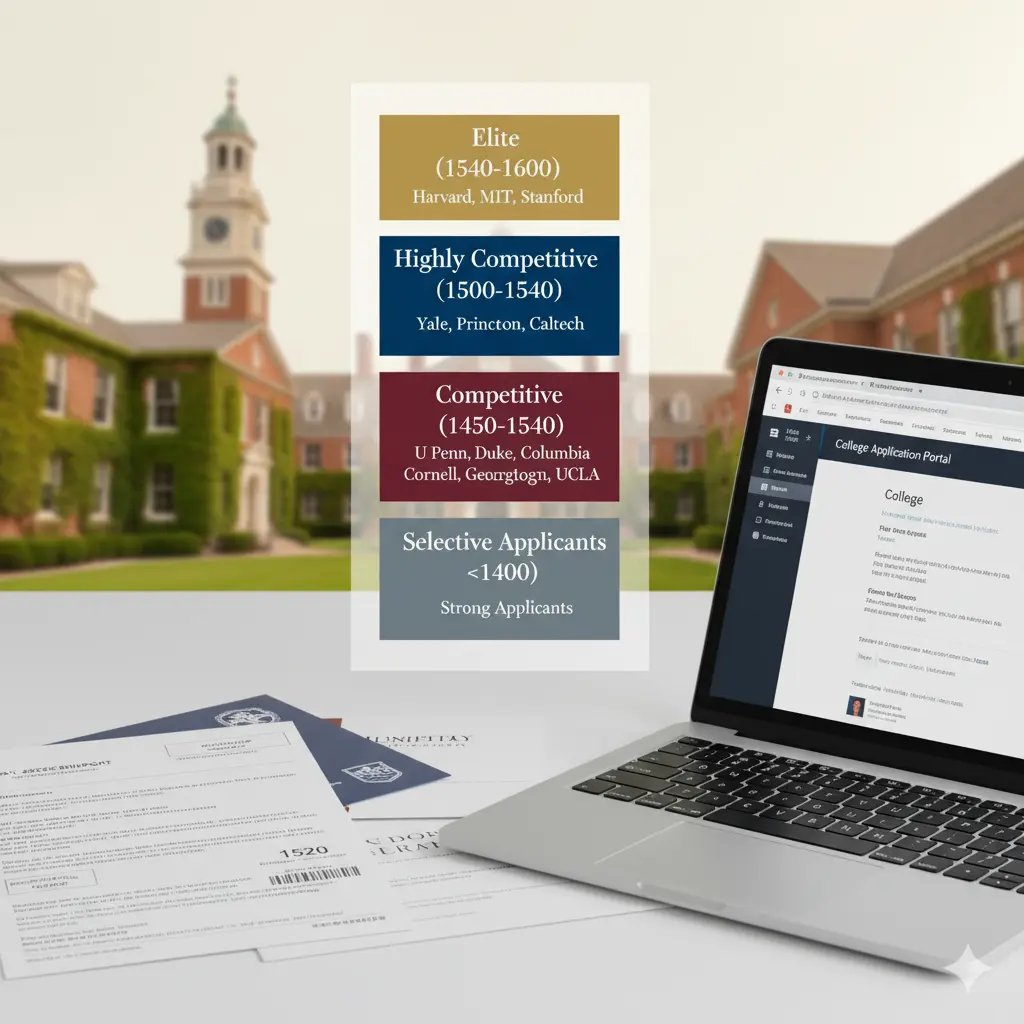
Score Tiers for Top Universities
| University Tier | Competitive Score Range | Super Competitive | Examples |
|---|---|---|---|
| Top 10 | 1470-1580 | 1540+ | Harvard, MIT, Stanford |
| Top 11-20 | 1410-1570 | 1520+ | Northwestern, Vanderbilt, Rice |
| Top 21-35 | 1370-1530 | 1480+ | Michigan, Virginia, USC |
| Top 36-50 | 1280-1490 | 1420+ | Wisconsin, UIUC, Ohio State |
Beyond the Numbers
While SAT score requirements are important, remember that top universities use holistic admissions:
- GPA and Course Rigor: Taking challenging courses with high grades
- Extracurricular Activities: Leadership, commitment, and impact
- Essays: Compelling personal narratives and supplemental responses
- Letters of Recommendation: Strong endorsements from teachers and counselors
- Demonstrated Interest: Engagement with the university
If your current scores are below your target range, read our guide on How to Improve Your SAT Score by 200+ Points for proven strategies.
Frequently Asked Questions
Ivy League schools typically accept students with SAT scores in the 1470-1580 range (middle 50%). To be competitive, aim for 1500+. However, scores below this range can still be competitive with exceptional extracurriculars, essays, and GPA. Remember that Ivy League admissions are holistic—no single score guarantees admission.
Most top universities have adopted test-optional policies for 2025-2026, but several still require SAT scores including MIT, Caltech, Georgetown, and Dartmouth. Even at test-optional schools, submitting strong SAT scores can strengthen your application. Check each university's specific policy before deciding whether to submit scores.
For top 50 universities, competitive SAT scores generally range from 1280-1580, with most schools having a middle 50% range between 1370-1550. Schools ranked in the top 10 typically require 1470+, while schools ranked 21-50 are competitive with scores of 1370-1490. Use the specific ranges listed in this guide for your target schools.
Yes, a 1400 SAT score is competitive for many top 50 universities, particularly those ranked 20-50. For top 10 schools, you'll want to aim for 1500+ for the strongest chance. However, with exceptional grades, extracurriculars, and essays, students with 1400 scores have been accepted to top 20 schools. A 1400 score places you around the 94th percentile nationally.
Yes, test-optional schools will review and consider SAT scores if you choose to submit them. Strong scores can enhance your application by providing additional evidence of academic ability. Test-optional policies simply allow students to apply without scores if they feel their scores don't accurately reflect their abilities or would weaken their application.
Most students can improve their SAT scores by 100-200 points with dedicated practice. Students who practice for 80-120 hours typically see improvements of 200+ points. The key is consistent practice with official materials, identifying weaknesses, and using targeted study strategies. Learn specific improvement techniques in our SAT improvement guide.
If your score is more than 50 points below your target school's middle 50% range, retaking the SAT can significantly improve your chances. Most students improve on their second attempt. However, if you're within 50 points of the range and have strong other components of your application, one retake may be sufficient. Many schools superscore, so taking the test multiple times can help maximize your results using our SAT Superscore Calculator.
Conclusion: Using SAT Scores Strategically
Understanding SAT score requirements for top universities is essential for strategic college planning. While these middle 50% ranges provide valuable targets, remember that admission to elite schools depends on multiple factors beyond test scores.
Key Takeaways:
- Top 10 universities typically require scores of 1470-1580
- Ivy League schools have middle 50% ranges of 1470-1580
- Top 20 schools are competitive with scores of 1410-1570
- Top 50 schools have ranges from 1280-1530
- Test policies vary: some test-required, some test-optional, some test-blind
- Strong scores strengthen applications even at test-optional schools
- Holistic admissions consider GPA, activities, essays, and recommendations
Your Next Steps
- Calculate Your Current Score: Use our SAT Score Calculator to see where you stand
- Identify Target Schools: Make a list of 8-12 schools across different selectivity ranges
- Set Score Goals: Target the 75th percentile (top of the middle 50%) for reach schools
- Create a Study Plan: If needed, develop a strategic improvement plan
- Understand Policies: Check each school's current testing policy
- Consider Superscoring: Use our Superscore Calculator to maximize results
- Build a Balanced Application: Focus on all components, not just test scores
If your scores are below your target range, don't be discouraged. Read our comprehensive guide on How to Improve Your SAT Score by 200+ Points for proven strategies to boost your performance. For section-specific help, check out our SAT Reading Strategies guide.
The landscape of college admissions continues to evolve. Stay informed about testing policy changes at your target schools, and remember that while SAT scores matter, they're just one piece of your application puzzle. Focus on building a well-rounded profile that showcases your unique strengths, achievements, and potential.
SAT score data sourced from official university Common Data Sets, College Board statistics, and institutional research offices for the Class of 2028 admissions cycle.
About the Author